
A New Income Tax Bill – Or Just More Eyewash?
Blog post description.
Joachim Saldanha
2/4/20252 min read
Yesterday, the Indian finance minister announced that a new Income Tax Bill will be introduced within a week. The pitch? A law that is nearly half the size of the current Income-tax Act, 1961, both in terms of chapters and words, and a tax system that follows a "Trust first, scrutinize later" approach.
Sounds great in theory. But where is the transparency? Where is the detailed report explaining the rationale behind these sweeping changes?
Historically, every major tax law overhaul in India has been preceded, or at the very least, accompanied by a detailed, public report, justifying the proposed reforms:
📌 1922 – The recommendations of the All-India Income-tax Committee Report formed the basis for the enactment of the Indian Income-tax Act, 1922, which replaced the Indian Income-tax Act, 1918.
📌 1939 – The recommendations of the Ayers Income-tax Enquiry Committee Report (1936), which built upon the findings of the report of the Indian Taxation Enquiry Committee (1924-25), resulted in major amendments to the Indian Income-tax Act, 1922.
📌 1961 – The Income-tax Act, 1961, which replaced the 1922 Act, was based on extensive recommendations from the Matthai Taxation Enquiry Commission (1953-54), the 12th Report of the Law Commission of India on the Income Tax Act, 1922 (1958), and the Direct Taxes Administration Enquiry Committee (1959-61).
📌 Post liberalization in 1991, significant amendments to the Income Tax Act, 1961 have generally been accompanied by detailed reports e.g., the Chelliah Tax Reforms Committee Report (1991-93), the Report of the Kelkar Task Force on Direct Taxes.
📌 2010 – Even the aborted draft Direct Taxes Code (DTC) was released with an explanatory report.
📌 2012 – The introduction of General Anti-Avoidance Rules (GAAR) followed a detailed report from the Shome Expert Committee on the GAAR.
That brings us to today.
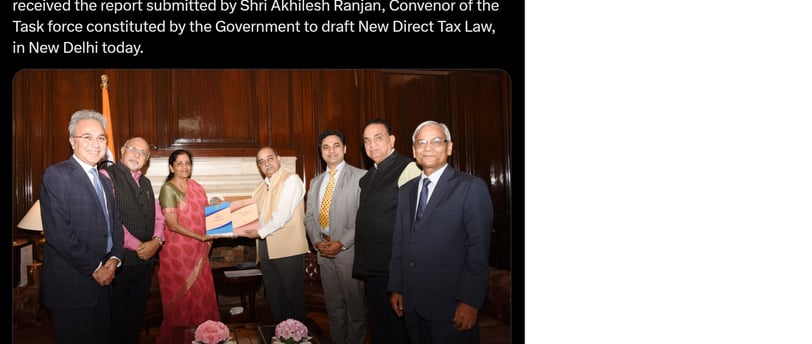
In 2017, the government constituted a Task Force for a New Direct Tax Law. Its report was submitted in 2019.
🔍 Where is the 2019 Task Force Report?
🔍 Why has it not been made public?
🔍 Why has it taken almost six years to act on its findings—if at all?
This is not how a participatory, deliberative democracy functions. What the finance minister really seems to mean when she says "Trust first, scrutinize later," is that it's the taxpayers who should trust first and verify later.
Absurd.
If this reform is genuine, let’s start with full transparency. Release the 2019 Task Force report. Release the stakeholder comments received. Allow public debate. Anything less is just an opaque, unilateral rewrite of India’s tax laws – dressed up as simplification.